
IT support is one of the most common entry points into Germany’s technology sector. Companies, hospitals, logistics businesses and public organisations all depend on IT staff to keep computers, user accounts, devices and networks running smoothly. Jobvector currently reports strong demand for IT support professionals, with many employers looking for qualified candidates.
This guide is for international job seekers, career changers and experienced helpdesk professionals who are considering IT support jobs in Germany. You’ll find information about the work itself, the cities where these jobs are available, common skills and language requirements, salary expectations, possible work-permit routes and practical tips for applying.
IT Support Specialist Jobs in Germany: Job Summary
| Item | What to expect |
|---|---|
| Common job titles | IT-Support (m/w/d), IT-Supporter, IT Support Specialist, Service Desk Agent, Helpdesk Mitarbeiter, 1st/2nd Level Support |
| Support levels | L1 usually handles the first contact and ticket triage. L2 takes on more detailed troubleshooting, while L3 generally deals with specialist or engineering-level problems. This is common industry practice rather than a legal classification. |
| Typical entry route | A dual IT apprenticeship such as Fachinformatiker/in Systemintegration, an IT-related degree, or further training supported by practical experience. |
| Typical gross pay | Roughly €36,000–€55,000 per year, depending on the source, experience level and location. |
| Language | German is commonly required for user-facing support roles, although some international employers operate mainly in English. The individual job advertisement is the deciding factor. |
| Work permit | EU citizens can live and work in Germany without a visa. Non-EU citizens need an appropriate residence permit. |
You may also notice (m/w/d) in German job advertisements. This stands for male/female/diverse and is a standard equal-opportunity designation, not an additional job requirement.
Where the Jobs Are: Locations and Work Settings

Germany’s larger cities have a strong concentration of IT support vacancies. StepStone lists Berlin, Munich and Hamburg among the cities with many IT support openings. Salaries can also vary by location. Larger cities often offer higher pay, although living costs tend to be higher as well. Jobvector’s data for IT-Supporter positions shows Frankfurt am Main with a city average of around €45,000.
IT support jobs are not limited to Germany’s biggest cities, however. Manufacturers, hospitals, retailers, logistics companies and IT service providers also need support staff in smaller cities and industrial areas.
CareerGen’s own vacancy coverage reflects this spread, including L1 IT Support Engineer jobs in Chemnitz, Berbersdorf, Mannheim and Melsungen, IT Support Engineer jobs in Hamburg and L1/L2 on-site positions in Schönebeck and Ilsenburg.
The working environment can also differ from one employer to another. Many support positions are on-site or hybrid because employees may need to handle hardware, printers and other equipment in person. Fully remote positions are available, but they are less common for entry-level support work. Always check the specific job advertisement for the employer’s working model.
What Does an IT Support Specialist Do?
An IT support specialist spends much of the working day helping employees solve technical problems. Depending on the company and seniority, the job can involve handling support tickets, diagnosing problems remotely, replacing hardware, setting up devices, managing user accounts and permissions, updating knowledge-base articles, training users and working with system administrators, developers or external providers.
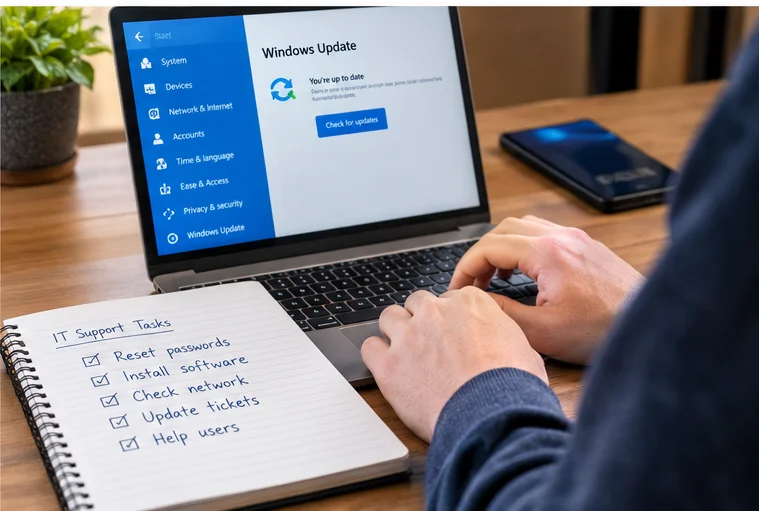
Typical tasks include:
- Resetting passwords and unlocking user accounts
- Installing and updating software
- Troubleshooting printers, VPNs, email and network-access problems
- Preparing laptops and phones for new employees
- Escalating more complicated issues to L2, L3 or an external vendor
- Recording solutions and troubleshooting steps so other team members can use them later
The exact responsibilities depend on the company, support level and industry.
Technical Skills Employers Commonly Ask For
The requirements are different from one vacancy to another, but several technical skills appear regularly in IT support job advertisements.
- Windows and Microsoft 365: Many support career paths begin with Windows client support and gradually move into broader system responsibilities involving Active Directory, Azure AD/Entra ID and Microsoft 365.
- Identity and access management: Basic knowledge of Active Directory or Entra ID, group policies and user permissions can be useful.
- Ticketing systems: Tools such as ServiceNow, Jira Service Management and Zendesk are commonly used. Understanding how ticketing and support workflows work is often more important than knowing one particular platform.
- Networking basics: You should be comfortable with concepts such as IP addresses, DNS, DHCP, VPNs and Wi-Fi troubleshooting.
- Hardware and mobile devices: Experience with laptops, docking stations, smartphones and device-management systems can be valuable.
- Basic scripting: PowerShell knowledge is often an advantage.
- Certifications: Certifications are not mandatory for every role, but ITIL 4 Foundation, CompTIA A+/Network+ and Microsoft fundamentals or endpoint-administrator certifications can strengthen a CV, especially if you do not have German IT qualifications.
Technical knowledge is only part of the job. Support professionals also need to communicate clearly with people who may not have a technical background. Patience, good documentation habits and the ability to prioritise several problems at once are important in day-to-day support work.
Experience and Qualifications
Germany has a strong tradition of formal vocational training, and one common route into IT is a dual apprenticeship such as Fachinformatiker/in Systemintegration. An IT-related university degree or additional training combined with practical experience can also lead to support positions.
A degree is not necessarily required for every L1 support role. Career changers may also be considered when they can demonstrate practical IT skills, relevant certifications and experience dealing with customers or users.
If you are coming from a customer-service background, our Hamburg guide to jobs without experience explains how customer-facing roles can provide useful experience when moving toward other types of work.
If you completed your IT training outside Germany, professional recognition may also be worth considering. The official Anerkennung in Deutschland portal explains recognition options for people with IT vocational qualifications and information about skilled IT workers. See its page on IT specialists and skilled IT workers.
Language Requirements for IT Support Jobs
This section provides general guidance rather than an official legal requirement.
Language requirements depend heavily on the employer and the type of support position.
- User-facing roles at German companies: German at around B2 or higher is common because support staff often communicate with colleagues by phone, email and in person.
- International companies and shared-service centres: English-first and bilingual positions do exist. However, these vacancies can attract many applicants, and German can still be useful in everyday workplace communication.
- Visa language requirements: Immigration and visa rules are separate from an employer’s language requirements and depend on the residence-permit route.
The language requirement written in the individual job advertisement should therefore be your main guide. If you are currently improving your German, our guide to German-speaking jobs in Europe explains how language skills can affect the range of positions available to you.
IT Support Salary in Germany
There is no single official salary figure for “IT support” in Germany. Job titles, industries, experience levels and locations all affect pay. Salary websites also use different methods and datasets, so their figures can vary.
| Source | Title used | Reported figure |
|---|---|---|
| jobvector | IT-Support | About €50,000 average gross per year, with a typical range of €42,000–€61,000, based on 2,617 salary entries, updated September 2026 |
| jobvector | IT-Supporter | About €40,000 average, with entry-level pay near €39,840 |
| Glassdoor | IT Support | About €43,100 average, with a typical range of €35,550–€54,500, based on 443 salaries in June 2026 |
| StepStone | IT Support | About €39,200 average, with entry-level pay near €36,000 and about €50,020 with experience |
| Payscale | IT Support Specialist | About €48,668 average base salary for mid-career professionals, with a 10th–90th percentile range of roughly €34,000–€74,000 |
| Brutto-Netto-Gehaltsrechner | IT Support Specialist | Monthly gross figures of about €3,460 for entry-level, €3,790 median and €4,210 senior |
Taken together, these figures indicate that entry-level IT support positions often fall somewhere in the high €30,000s to low €40,000s per year. More experienced or specialised positions can move into the high €40,000s and beyond.
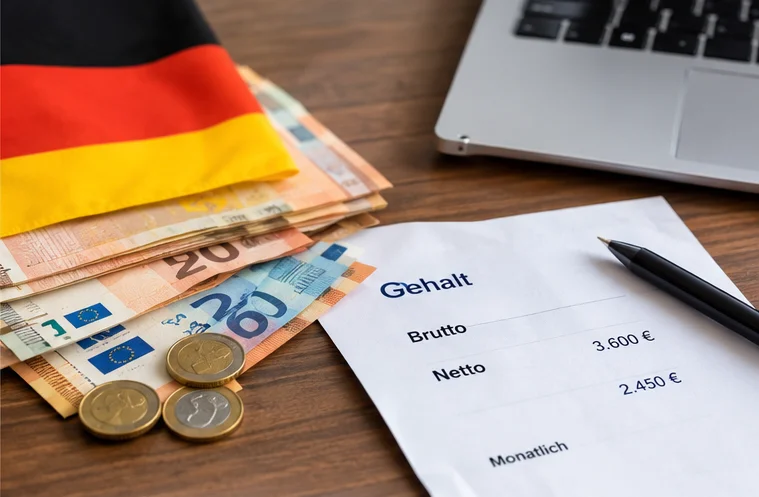
These are salary-survey figures, not guarantees. All figures are gross amounts before tax and social-security contributions. Your actual take-home pay will depend on factors such as your tax class and personal circumstances. When applying, always use the salary stated in the individual vacancy or employment contract as the most relevant figure.
Work Permit and Visa Routes for Non-EU Applicants
German immigration rules can change, so the information below should be treated as a general overview rather than legal advice. Before making immigration decisions, check the latest information from Make it in Germany and your local German embassy or consulate.
1. EU Blue Card
For 2026, the standard minimum gross annual salary is €50,700. A lower threshold of €45,934.20 applies to certain shortage occupations, recent graduates and qualifying IT specialists.
IT specialists without a university degree may qualify under certain conditions if they have at least three years of relevant IT experience gained within the previous seven years.
The employment normally needs to last for at least six months and correspond to the applicant’s professional qualifications. The German Embassy’s EU Blue Card information sheet provides documentation information, although the linked document was prepared for applicants in the United States and contains earlier salary figures. Check the current requirements for your country before applying.
For the salary calculation, the guaranteed fixed gross salary is relevant. Bonuses, commissions, stock options and allowances may not count toward the required amount.
Under certain conditions, Blue Card holders can qualify for a settlement permit after 21 months with German at B1 level or after 27 months with German at A1 level.
2. Experience-Based Route for IT Specialists
The official Anerkennung in Deutschland information explains that experienced IT specialists may be able to work in Germany without a formal IT qualification or university degree under certain conditions.
At least two years of relevant IT experience can be important for this route, and a minimum salary also applies. Because salary figures can change, check the current amount through the official German immigration information before relying on it.
3. Opportunity Card (Chancenkarte)
Germany introduced the Opportunity Card, or Chancenkarte, on 1 June 2024 under Section 20a of the Residence Act.
The permit can allow eligible applicants to stay in Germany for up to 12 months while looking for employment. It permits part-time work of up to 20 hours per week and trial employment of up to two weeks per employer.
Applicants can qualify through a recognised qualification or, in relevant cases, by reaching at least six points under the points system. The baseline language requirement is A1 German or B2 English. Additional points can be available for higher levels of German.
Applicants also need to demonstrate sufficient financial resources. For 2026, the amount is approximately €1,091 per month, or €13,092 for a full year.
The Chancenkarte information portal provides a points calculator, but applicants should confirm their individual situation with an official source.
A Practical Check Before You Apply
Many of the salaries listed in the table above are below the €45,934.20 reduced Blue Card threshold for 2026. As a result, some first-line IT support jobs may not meet Blue Card salary conditions, while higher-level support, systems administration and specialist positions may be more likely to reach the required salary.
This is an interpretation of the salary data rather than a guarantee about any individual position. If you need a particular residence permit, ask the employer whether the proposed contract and salary meet the relevant requirements before relying on the job offer.
Visa sponsorship should never be assumed.
Career Prospects in IT Support
IT support can be the beginning of a longer IT career. As you gain experience, there are several directions you can take.
Common career paths include:
- Moving from L1 to L2 and L3 support or into a team-lead position
- Becoming a systems or network administrator
- Specialising in endpoint and device management, including Microsoft Intune or Jamf
- Moving into IT service management and ITIL-based processes
- Developing skills in cloud administration or IT security
StepStone’s salary data indicates that pay can increase from roughly €36,000 at entry level to around €50,020 with experience.
In practice, career progression depends on the employer, your technical skills, experience and responsibilities. Improving your German and adding one or two relevant certifications can also strengthen your profile.
How to Apply for IT Support Jobs in Germany
Finding the right vacancy is only the first step. A targeted application can make it easier for employers to see how your experience matches the position.
1. Search using German and English job titles.
Try terms such as:
- “IT-Support”
- “Service Desk”
- “1st Level Support”
- “Helpdesk”
- “IT-Administrator”
Using several search terms can help you find vacancies that use different titles for similar work.
2. Use established job platforms.
The Federal Employment Agency’s Jobsuche is one of Germany’s major job-search platforms. You can also check company career pages, general job portals and relevant vacancy articles on CareerGen.
3. Pay attention to the language requirement.
Only apply when your German or English skills reasonably match what the employer requests. Be accurate about your current level rather than overstating it.
4. Prepare a German-style CV.
A clear, reverse-chronological Lebenslauf is commonly used in Germany. Keep it focused, generally around one to two pages, and tailor it to the position. Highlight the systems, software and tools you have actually worked with. Include relevant certificates and reference letters where appropriate.
5. Keep your cover letter specific.
Instead of sending the same generic letter to every employer, explain why you are interested in the particular company and support environment. Mention one or two real technical problems you have solved.
6. Prepare for practical interview questions.
Support interviews can include scenario-based questions. For example, you might be asked what you would check first if a user suddenly could not log in to email.
Practise explaining technical problems in simple language, especially if the position involves direct contact with non-technical employees.
7. Review the contract carefully.
Before accepting an offer, check the contract type, gross salary, working hours, shifts or on-call requirements, workplace arrangement, working language and whether the employment conditions fit your intended visa or residence-permit route.
How to Avoid Fake IT Job Offers
Unfortunately, job seekers looking for work abroad can encounter fraudulent offers. A few basic checks can help you spot warning signs.
- Legitimate employers should not charge you fees for interviews, employment contracts or guaranteed visas.
- Check the company through its official website rather than relying only on a message from a recruiter.
- Be careful with offers promising a visa, accommodation and unusually high pay in exchange for very little work.
- Do not send passport or bank information until you have verified the employer and employment contract.
- Check visa and immigration procedures through the German embassy or official immigration sources instead of relying solely on a recruiter.
If an offer seems unusually good, take time to verify the employer and the vacancy before sending personal documents or making payments.
Frequently Asked Questions
Can I get an IT support job in Germany without speaking German?
Yes, some international companies advertise English-speaking IT support positions. However, the number of these jobs is smaller, and they can attract many applicants. Because many user-facing support roles require German, improving your German can give you access to a wider range of vacancies.
Do I need a degree to work in IT support in Germany?
Not necessarily. Some people enter the field through a vocational apprenticeship or additional training combined with practical experience.
For immigration purposes, however, the requirements depend on the residence-permit route. Certain routes can allow experienced IT specialists to qualify without a university degree.
What is the average IT support salary in Germany?
The salary sources covered in this guide report averages ranging from roughly €39,000 to €50,000 gross per year, depending on the job title and source.
Because salary data varies, always check the exact amount offered in the individual job advertisement and employment contract.
Can an IT support specialist get an EU Blue Card?
It is possible in certain circumstances if the position, qualifications or experience and salary meet the applicable requirements.
For 2026, the reduced salary threshold is €45,934.20 for qualifying IT specialists. Some entry-level IT support jobs may fall below that figure, so applicants should check the specific job and confirm the current immigration requirements with official sources.
Can I apply for an IT support job before moving to Germany?
Yes. You can apply for jobs from abroad and complete interviews remotely when an employer offers that option.
Eligible applicants can also use the Opportunity Card to search for employment in Germany for up to 12 months, subject to the relevant requirements.
How long does it take to qualify for permanent settlement?
For certain Blue Card holders, a settlement permit may be possible after 21 months with German at B1 level or after 27 months with German at A1 level, provided the other requirements are met.
Other residence permits have different rules, so the timeline depends on your specific immigration route.
Conclusion
IT support can provide a practical way to enter Germany’s technology sector and build toward more specialised IT roles. The right opportunity will depend on your technical experience, language skills, qualifications and immigration situation.
Start by identifying the type of support role that matches your current skills. Then check the language requirement, salary, working conditions and residence-permit requirements before applying.
A tailored German-style CV and a clear explanation of your practical IT experience can also make your application more relevant to employers.
You can browse our current IT support vacancy write-ups and use Make it in Germany to verify the latest immigration information before accepting an offer.

1 thought on “IT Support Specialist Jobs in Germany: Salary, Skills and How to Apply”