
Germany has a strong healthcare system and continues to offer opportunities for qualified nursing professionals, including nurses trained outside Germany. But getting a nursing job is not simply a matter of finding a vacancy and submitting a CV.
Nursing is a regulated profession in Germany, which means internationally trained nurses usually need to have their qualifications recognised and obtain the required professional authorisation before they can work as fully qualified nurses.
For applicants coming from abroad, the process can include qualification recognition, German-language requirements, professional licensing, job applications and, for people outside the EU/EEA, immigration requirements.
This guide explains what you need to know about registered nurse jobs in Germany, including nursing responsibilities, qualifications, German-language requirements, salary considerations, recognition of foreign qualifications, where to search for vacancies and how to apply.
If you’re interested in other healthcare opportunities, you can also explore CareerGen’s Healthcare & Nursing jobs in Germany.
Registered Nurse Jobs in Germany: Overview
Registered nurses can work in many different areas of Germany’s healthcare system. Depending on their experience and specialisation, nurses may work in hospitals, care homes, rehabilitation centres or community-based services.
Common workplaces include:
- Hospitals
- Nursing and residential care facilities
- Rehabilitation centres
- Outpatient care services
- Specialist healthcare facilities
- Elderly-care institutions
- Other medical and care organisations
Internationally trained nurses may come across professional titles such as Pflegefachfrau, Pflegefachmann or Pflegefachperson in Germany.
Because nursing is regulated, foreign-trained nurses generally need official recognition of their qualification before they can practise as fully authorised nursing professionals. The official Make it in Germany portal provides information about the requirements for working as a nurse in Germany.
What Does a Registered Nurse Do in Germany?

The day-to-day work of a registered nurse depends on the employer, department, specialisation and type of healthcare facility.
Typical responsibilities can include:
- Assessing and monitoring patients
- Providing nursing and personal care
- Helping patients with everyday activities
- Administering medication according to authorised procedures
- Watching for changes in a patient’s condition
- Recording patient information and care activities
- Supporting doctors and other healthcare professionals
- Assisting patients during treatment and recovery
- Communicating with patients and their families
- Following hygiene and infection-control procedures
- Taking part in shift handovers
- Working as part of a multidisciplinary healthcare team
The actual responsibilities should always be checked in the individual job advertisement, as employers can have different expectations.
Where Can Nurses Find Jobs in Germany?
Nurses are needed across several areas of the German healthcare system. Your options may depend on your qualifications, experience, language skills and professional recognition status.
Hospitals
Hospitals employ nurses in departments such as general medicine, surgery, intensive care, emergency care and various specialist units.
Nursing and Residential Care
Nursing homes and residential care facilities employ nursing professionals to provide both medical and everyday care to residents.
CareerGen also publishes opportunities in this area. For example, its Pflegehilfskraft job in Herne covers a position with KORIAN Holding GmbH and provides an example of nursing-assistant work.
It’s important to distinguish nursing-assistant positions from fully qualified registered nursing roles because the qualification and professional requirements can be different.
Outpatient Care
Outpatient nursing services provide care to people in their homes and local communities. This can be an option for nurses who prefer community-based care rather than working in a hospital.
Rehabilitation
Rehabilitation centres may employ nurses who help patients during recovery following illness, injury or medical treatment.
For more healthcare opportunities, you can browse the CareerGen Healthcare & Nursing category.
Qualifications for Registered Nurse Jobs in Germany
One of the first things an internationally trained nurse should check is whether their qualification can be recognised in Germany.
Nursing is a regulated profession, so having a nursing qualification from another country does not automatically give you permission to work as a fully authorised nurse in Germany.
The recognition authority compares your foreign qualification with the relevant German reference qualification. If substantial differences are found, you may need to complete an additional measure before recognition can be granted.
Depending on the individual case, this can include an adaptation period or an examination.
For that reason, international nurses should investigate the recognition process before assuming that their existing qualification will automatically be accepted.
German Language Requirements for Nurses
German is an important part of working as a nurse in Germany. Nurses communicate with patients, relatives, doctors and other healthcare professionals throughout the working day, so being able to understand and communicate clearly is essential.
According to the current official German information, B2-level German under the Common European Framework of Reference for Languages (CEFR) is required for recognition as a nursing professional.
The Recognition Finder also lists B2 German for recognition as a general nurse and notes that a specialist language examination may be required in some cases.
Because requirements can depend on the responsible authority, applicants should check exactly which language certificate or evidence they need.
Why German Is Important Beyond Recognition
Language skills are not only about meeting an administrative requirement. Nurses may need German every day to:
- Communicate with patients
- Understand medical instructions
- Document patient care
- Participate in shift handovers
- Speak with patients’ relatives
- Work with doctors and other healthcare professionals
- Follow workplace procedures and safety requirements
For international nurses, learning German should therefore be treated as part of preparing for the profession itself, not simply as another step in the paperwork.
Recognition of Foreign Nursing Qualifications
Internationally trained nurses generally need to complete Germany’s professional recognition process.
During this process, the responsible authority compares the foreign nursing qualification with the appropriate German reference qualification.
The process can generally involve:
- Submitting an application
- Providing education and professional qualification documents
- Having the qualification assessed
- Receiving a recognition decision
- Completing an adaptation period or examination if substantial differences are found
- Meeting any additional requirements for professional authorisation
The official Make it in Germany recognition procedure information states that competent authorities generally assess complete documentation within around three to four months. The actual timeframe can vary depending on the case and the responsible authority.
You can also use the official Anerkennung in Deutschland Recognition Finder to find the relevant recognition procedure and competent authority.
What Documents May Be Required?
The exact documents depend on your individual circumstances and the authority handling your application.
Depending on the case, you may be asked for:
- Nursing diploma or professional qualification
- Academic or vocational transcripts
- Training records
- Evidence of professional experience
- Passport or identity documents
- Evidence of German-language skills
- Professional registration documents
- Medical fitness documentation
- Evidence of personal suitability or good conduct
- Certified translations, where required
There is no single document checklist that applies identically to every applicant.
Before submitting your application, check the requirements with the responsible recognition authority.
How Long Does Nursing Recognition Take?
Official German recognition information indicates that complete applications are generally assessed within approximately three to four months.
That should not be viewed as a guaranteed completion time, however.
The process may take longer if:
- Documents are incomplete
- The authority requests additional evidence
- Required translations are missing
- Substantial differences are identified
- An adaptation programme is required
- An examination is necessary
For this reason, international nurses may benefit from starting the recognition process as early as possible.
Registered Nurse Salary in Germany
There is no single salary that applies to every registered nurse in Germany. Pay can vary depending on several factors, including:
- Location
- Employer
- Professional experience
- Qualification
- Specialisation
- Collective agreement
- Working hours
- Shift work
- Additional allowances
When looking at a job advertisement, pay close attention to whether the advertised amount is gross or net and whether it applies to full-time or part-time employment.
For a particular vacancy, the salary stated by the employer should be treated as the relevant figure rather than applying a general national average.
Because salary statistics can change and may differ according to occupational classification, applicants comparing nursing salaries can check the current Federal Employment Agency Entgeltatlas.
Are Registered Nurses in Demand in Germany?
Nursing remains an important area of employment in Germany.
Current information from Make it in Germany reports approximately 1.8 million people working in nursing-sector jobs subject to compulsory social insurance, with foreign nationals accounting for around 20% of that workforce. The same source reports approximately 31,000 vacant positions in care facilities.
These figures describe the wider nursing sector. They should not be interpreted as a guarantee that every individual applicant will find a job.
Individual employers may have their own requirements relating to:
- Professional recognition
- German-language ability
- Previous experience
- Specialisation
- Shift availability
- Work authorisation
- Location
Can Foreign Nurses Work in Germany?
Yes. International nurses can work in Germany when they meet the relevant professional and immigration requirements.
The process can differ depending on where the nurse was trained.
For nurses from EU/EFTA countries, different recognition rules may apply, including automatic recognition in certain circumstances.
For nurses from outside the EU/EFTA, the process generally involves professional recognition as well as obtaining an appropriate residence status.
According to official German information, third-country nurses whose qualifications have been fully recognised and who have the required professional licence can apply for the relevant residence permission for qualified employment when they also have a concrete nursing job offer.
If a qualification has only been partially recognised, an appropriate residence route for completing the required recognition measures may be available in certain circumstances.
Visa and Immigration Requirements for International Nurses
Immigration requirements depend on factors such as your nationality, qualification and professional recognition status.
For third-country nationals, the official Make it in Germany information on nursing and care professionals from abroad explains the different routes available depending on whether the nursing qualification has been fully or partially recognised.
If your nursing qualification has been fully recognised and you have the required professional licence and a concrete job offer, a work visa for qualified professionals may be relevant.
The official Work visa for qualified professionals information explains that regulated professions, including healthcare professions, require the appropriate professional licence.
If additional recognition measures are still required, you may need to investigate a residence route specifically related to completing recognition.
Immigration rules can change, so always check the latest official requirements before submitting a visa or residence application.
Is Visa Sponsorship Guaranteed for Nursing Jobs?
No.
The fact that nursing is an area of demand does not mean that every nursing vacancy offers visa sponsorship or relocation assistance.
Before applying, international candidates should check whether the employer:
- Accepts applications from outside Germany
- Recruits internationally
- Requires professional recognition before employment
- Provides relocation assistance
- Helps with immigration paperwork
- Requires a particular level of German
- Has specific professional licensing conditions
Never assume that a job provides visa sponsorship unless the employer clearly says so.
International applicants can also explore CareerGen’s Jobs for Foreigners in Germany category for relevant opportunities and information.
How to Find Registered Nurse Jobs in Germany
There are several places where you can search for nursing vacancies.
1. Employer Career Pages
Hospitals, care providers, healthcare organisations and nursing groups often advertise vacancies directly through their own websites.
Applying through an official employer website can also make it easier to confirm that a vacancy is genuine.
2. German Employment Resources
The Federal Employment Agency provides official employment information and job-search resources for people looking for work in Germany.
3. Make it in Germany Job Listings
The official Make it in Germany portal provides information for international professionals and also features job listings.
4. CareerGen
CareerGen publishes Germany-focused job opportunities and career information.
The Healthcare & Nursing section on CareerGen is particularly useful for nurses, caregivers and other healthcare professionals.
International applicants can also browse the Jobs for Foreigners category.
How to Apply for Registered Nurse Jobs in Germany
For international applicants, it helps to approach the process step by step.
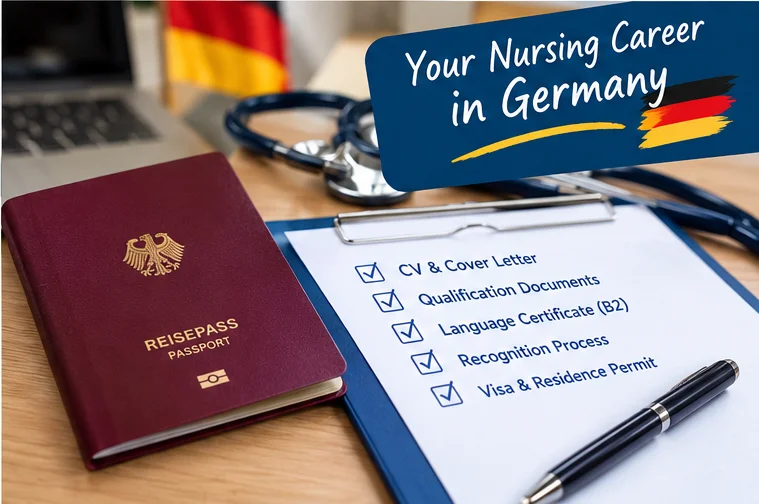
Step 1: Check Your Nursing Qualification
First, find out whether your qualification is eligible for recognition in Germany.
Step 2: Identify the Responsible Recognition Authority
Use the official Recognition Finder to identify which authority is responsible for your profession and intended location.
Step 3: Prepare Your Documents
Gather your nursing diploma, training records, evidence of professional experience, identification documents and language evidence.
Step 4: Work Toward B2 German
If you have not reached B2 German yet, plan your language preparation around the professional requirements.
Step 5: Search for Suitable Vacancies
Look for positions that match your qualifications, experience, language level and recognition status.
Step 6: Prepare Your CV
Your CV should give the employer a clear picture of your professional background.
Include:
- Nursing qualification
- Professional experience
- Clinical specialisations
- Relevant skills
- German-language level
- Other language skills
- Professional registrations
- Recognition status, if applicable
Step 7: Apply Through the Correct Channel
Follow the employer’s application instructions carefully and submit the documents requested in the vacancy.
Step 8: Complete Recognition and Immigration Requirements
If you are applying from abroad, complete the relevant professional recognition and immigration procedures before starting employment where required.
What Should International Nurses Include in Their CV?
A good nursing CV should make your professional background easy for an employer to understand.
Professional Profile
Start with a short summary of your nursing background, experience and areas of expertise.
Education
List your nursing qualification, educational institution and relevant dates.
Clinical Experience
Include your previous employers, departments, responsibilities and relevant clinical experience.
Skills
Highlight nursing, patient-care and other skills that are relevant to the position.
Language Skills
Clearly state your German level and any other languages you speak.
Recognition Status
If your nursing qualification has already been recognised in Germany, make this clear on your CV.
If recognition is still in progress, describe the current status accurately. Avoid giving the impression that recognition has already been completed when it has not.
Common Mistakes International Nurses Should Avoid
Assuming a Foreign Nursing Qualification Is Automatically Valid
Nursing is regulated in Germany. Before applying for positions as a fully qualified nurse, international applicants should understand the recognition requirements for their qualification.
Applying Without Checking German Requirements
B2 German is currently part of the recognition requirements for nursing professionals. Make sure you understand the language requirements that apply to your situation.
Assuming Every Job Offers Sponsorship
Visa or relocation assistance depends on the individual employer and the applicant’s circumstances.
Using Outdated Visa Information
Immigration rules can change. Always check current information through official German sources before making plans.
Paying Large Upfront Recruitment Fees
Be careful with recruiters who demand substantial upfront payments or promise guaranteed jobs, visas or unusually high salaries.
Sending Personal Documents to Unverified Websites
Before uploading your passport, certificates or other sensitive documents, make sure you are dealing with a genuine employer, recruitment organisation or official authority.
Registered Nurse Jobs in Germany: Application Checklist
| Requirement | What to check |
|---|---|
| Nursing qualification | Is your qualification recognised or eligible for recognition? |
| German language | Do you meet the required language level? |
| Recognition | Have you identified the competent authority? |
| Professional licence | Can you obtain the required authorisation? |
| Experience | Does the vacancy require specific experience? |
| Employer | Is the employer clearly identified? |
| Salary | Is the advertised amount gross or net? |
| Working hours | Is the role full-time, part-time or shift-based? |
| Location | Where is the actual workplace? |
| Immigration | Do you need a visa or residence permit? |
| Documents | Are translations or certifications required? |
Frequently Asked Questions
Do I need German to work as a registered nurse in Germany?
Yes. Current official German information states that B2 German under the CEFR is required for recognition as a nursing professional. Depending on the recognition procedure, a specialist language examination may also be required.
Is nursing a regulated profession in Germany?
Yes. Nursing is a regulated profession. Foreign-trained nurses generally need recognition of their qualification and the required professional authorisation before they can practise as fully authorised nursing professionals.
Can nurses from outside the EU work in Germany?
Yes, provided they meet the applicable professional and immigration requirements. The process depends partly on whether the nursing qualification has been fully or partially recognised.
How long does nursing qualification recognition take?
Official recognition information says that competent authorities generally assess complete documentation within around three to four months. Individual cases can take longer depending on the circumstances.
Can I apply for nursing jobs while recognition is in progress?
You may be able to contact or apply to employers while your recognition process is underway, depending on the vacancy and your circumstances.
However, you should not assume that you can work as a fully authorised nurse before meeting the applicable professional requirements.
Is visa sponsorship guaranteed for nursing jobs?
No. Visa sponsorship or immigration assistance depends on the individual employer and the applicant’s circumstances.
How can I check whether my nursing qualification is recognised?
Use the official Anerkennung in Deutschland Recognition Finder to identify the appropriate recognition procedure and responsible authority.
Where can I find nursing jobs in Germany?
You can search through employer career pages, German employment resources, official Make it in Germany job listings and CareerGen’s Healthcare & Nursing jobs section.
Are there nursing assistant jobs in Germany?
Yes. Nursing-assistant positions are different from fully qualified nursing roles and can have different qualification and professional requirements.
CareerGen currently features a Pflegehilfskraft job listing in Herne that provides an example of this type of position.
Conclusion
Registered nurse jobs in Germany can provide opportunities for qualified healthcare professionals, including nurses who completed their training abroad. However, international applicants need to understand the professional recognition process before treating a vacancy as a job they can immediately start.
The main areas to check are:
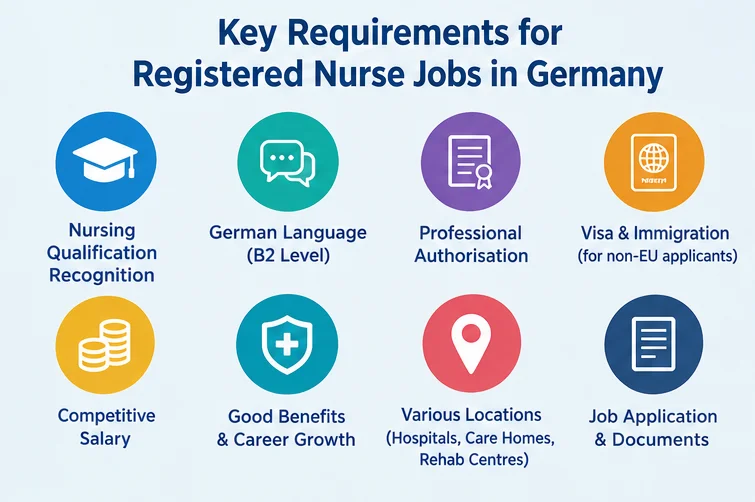
- Recognition of your nursing qualification
- German-language requirements
- Professional authorisation
- Employer requirements
- Salary and employment conditions
- Work authorisation
- Visa or residence requirements
For the latest information about recognition and immigration, use Germany’s official sources. For specific job vacancies, always check the details directly with the employer.
If you’re looking for more healthcare opportunities, visit CareerGen’s Healthcare & Nursing jobs in Germany section. Applicants coming from outside Germany can also explore the Jobs for Foreigners category.

1 thought on “Registered Nurse Jobs in Germany: Salary, Requirements and How to Apply”