
Germany’s transport and logistics industry relies on professional truck drivers to keep goods moving between warehouses, factories, distribution centres, ports and customers. For qualified drivers, truck driver jobs in Germany can offer opportunities in local deliveries, regional transport and long-distance freight operations across Germany and Europe.
The route into this type of work depends on several factors. Your driving licence, professional driver qualification, experience, nationality and right to work in Germany can all affect which jobs you can apply for.
For drivers coming from outside the EU or EEA, there are additional immigration and licence requirements to understand before accepting a job.
This guide explains what truck drivers typically do in Germany, which licences are used, what employers look for, how much drivers earn, what working hours can be like, and what international applicants need to know before applying.
Truck Driver Jobs in Germany: Job Overview
Truck drivers in Germany work mainly in freight transport and logistics. Depending on the employer, a driver might make local deliveries, operate on regional routes or spend several days travelling between cities and countries.
Common employers include:
- Logistics companies
- Freight forwarding companies
- Distribution companies
- Manufacturing companies
- Retail and wholesale businesses
- Food and beverage distributors
- Construction companies
- Transport operators
- Specialist freight companies
Road transport plays an important role in Germany’s freight industry, and professional drivers are an established occupation within the country’s transport sector. The official [Make it in Germany transport careers guide] provides additional information for people interested in professional driving in Germany.
CareerGen also covers opportunities in other industries. If you’re considering a career outside logistics, you can explore our guides to IT Support Specialist Jobs in Germany and Registered Nurse Jobs in Germany.
What Does a Truck Driver Do in Germany?
The daily routine depends on the employer, vehicle and route. A local delivery driver, for example, may have a very different schedule from someone working on international freight routes.
Typical responsibilities include:
- Driving heavy goods vehicles safely
- Collecting and delivering goods
- Checking delivery and transport documents
- Securing cargo before departure
- Inspecting the vehicle before and during journeys
- Following planned routes and delivery schedules
- Communicating with dispatchers and customers
- Loading or unloading goods when required
- Reporting vehicle problems or delivery issues
- Following road-traffic and transport regulations
- Recording driving, working and rest periods where required
Long-distance and international drivers may spend several days away from home. Local and regional drivers generally return to their home base more frequently.
For this reason, it’s worth checking the route pattern and schedule carefully before applying. The job title alone doesn’t tell you what the working week will look like.
Truck Driver Licence Requirements in Germany
The driving licence you need depends on the type of vehicle you will operate.
German professional-driving requirements include licence categories such as:
- C1
- C1E
- C
- CE
- D1
- D1E
- D
- DE
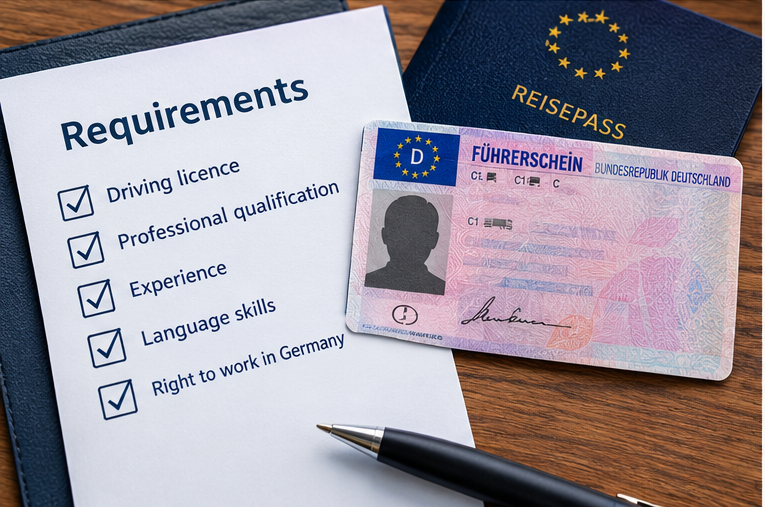
For heavy goods vehicles, C and CE are particularly important. CE is generally associated with heavier vehicle combinations involving trailers or semi-trailers.
However, not every truck-driving vacancy has exactly the same requirements. Always check the individual job advertisement to see which licence category the employer expects.
The official Make it in Germany information for professional drivers explains the licence and qualification requirements in more detail.
What Is a CE Licence?
The CE licence is commonly relevant to drivers operating heavy trucks with trailers or semi-trailers.
If you are applying for a German truck-driving position, don’t simply write “truck licence” on your CV. Clearly state whether you hold a C, CE or another relevant category and mention the country where the licence was issued.
That makes it much easier for an employer to understand your qualifications.
Professional Driver Qualification
A driving licence is not necessarily the only qualification required for professional freight driving.
Germany has additional professional-driver qualification rules. Under the applicable regulations, drivers operating vehicles covered by the rules for professional goods transport need the required initial qualification or accelerated initial qualification.
Professional drivers also have ongoing training requirements. The official German Professional Driver Qualification Act provides the legal framework for these qualifications and further training requirements.
The Make it in Germany professional-driver guidance is also useful for international applicants because it explains how the licence and qualification requirements work when moving to Germany.

Can Foreign Truck Drivers Work in Germany?
Yes, foreign drivers can work in Germany, but the process depends on their nationality, driving licence, professional qualifications and immigration status.
EU and EEA citizens generally have a different route into the German labour market from people arriving from countries outside the EU/EEA.
For third-country nationals, Germany has specific rules for employing professional drivers. The Federal Employment Agency can approve employment under the applicable rules when the required conditions are met.
This means having a truck-driving licence from your home country does not automatically mean you can start working as a professional driver in Germany.
The official Make it in Germany guidance for professional drivers from third countries explains the current requirements.
If You Already Have the Required Qualification
If you already have the necessary professional driving qualification and meet the applicable immigration requirements, you may be able to enter Germany for employment as a professional driver.
For third-country nationals, the relevant residence and employment rules still apply, and approval from the Federal Employment Agency forms part of the process.
It’s therefore important to check your individual situation before travelling or paying recruitment-related costs.
If You Do Not Yet Have an EU/EEA Truck Licence
There is also a route for some international applicants who do not yet have the required EU or EEA driving licence or initial qualification.
Under certain conditions, an applicant can enter Germany for qualification measures and work in another role while completing the required training and licence process.
The official guidance states that, in the applicable arrangement, the necessary German licence, qualification and any required language skills must be achievable within 15 months.
During the qualification period, the person cannot work as a professional driver until the necessary requirements have been completed.
Converting a Foreign Driving Licence
If you already have a truck licence from outside the EU or EEA, check the conversion rules before assuming that your licence can be used indefinitely in Germany.
According to the current Make it in Germany guidance, third-country drivers generally need to exchange their foreign driving licence for a German licence within six months after registering their residence in Germany.
The process depends on the country that issued the licence.
For some countries, conversion may be possible without the same level of testing. In other cases, applicants may need to pass both theoretical and practical tests.
Because the rules depend on the issuing country, check your individual case with the responsible German driving-licensing authority.
Experience Requirements for Truck Driver Jobs
Experience requirements can vary significantly from one employer to another.
Some companies may consider drivers with limited professional experience, particularly where training is available. Other employers may ask for several years of experience with heavy vehicles, trailers or international freight.
Employers may look at:
- Previous truck-driving experience
- Experience with C or CE vehicles
- Domestic or international driving experience
- Trailer or semi-trailer experience
- Knowledge of transport documentation
- Safe-driving record
- Experience with particular types of cargo
- Route-planning experience
- Experience loading and securing goods
The job advertisement should always be your first reference for vacancy-specific requirements.
If you’re looking at other entry-level opportunities in Germany, CareerGen also has a guide to jobs without experience in Hamburg.
Skills Employers Look For
Being a truck driver involves more than simply operating a large vehicle. Employers also need people who can manage schedules, communicate clearly and take responsibility for vehicles and cargo.
Safe Driving
Drivers need to operate heavy vehicles carefully in different traffic, road and weather conditions.
Time Management
Deliveries often have planned schedules. Drivers need to manage their journeys while also following legally required breaks and rest periods.
Vehicle Awareness
Drivers should be able to notice basic vehicle problems and report mechanical or safety issues when necessary.
Communication
Depending on the job, drivers may communicate with dispatchers, warehouse workers, customers and other transport professionals.
Organisation
Delivery documents, schedules and transport information need to be handled accurately.
Reliability
Transport companies depend on drivers to arrive as scheduled, follow procedures and look after vehicles and cargo responsibly.
German Language Requirements
German language requirements differ from one employer to another.
Some companies may expect German because drivers regularly communicate with customers, warehouse staff, dispatchers or authorities. International transport companies may have different requirements.
So, don’t assume that every truck driver job requires the same German language level.
Even when a vacancy does not specify a particular level, basic German can make everyday communication easier, particularly when dealing with colleagues, customers, road-related situations and administrative tasks.
CareerGen also publishes opportunities where German-language skills are specifically relevant, including our guide to German-speaking jobs in Europe.
Truck Driver Salary in Germany
Truck driver salaries depend on experience, location, employer, transport type, working pattern and other factors.
According to the Federal Employment Agency’s Entgeltatlas, the median monthly gross pay for the occupational group covering professional drivers in goods transport/HGV-related work is €3,196 for full-time employees in Germany. The data is from the 2025 Entgeltatlas.
The same data shows regional differences. For example, the median was reported at:
- €3,386 in Rhineland-Palatinate
- €3,368 in Baden-Württemberg
- €3,338 in Berlin
- €3,280 in North Rhine-Westphalia
- €3,267 in Bavaria
These figures are useful as a reference, but they are not a guaranteed salary for an individual truck driver. Actual pay can be different depending on:
- Driving experience
- Type of truck
- Local or international routes
- Employer
- Region
- Collective agreements
- Working pattern
- Overtime
- Allowances and other compensation
When looking at a job advertisement, check whether the salary is quoted as gross or net and whether allowances are included separately.
Working Hours and Driving Time
Truck driving doesn’t mean spending an entire working day behind the wheel without stopping. Professional drivers must follow rules covering driving time, breaks and rest periods.
For applicable professional driving situations, German rules include European requirements concerning driving time and rest. For example, drivers generally need a break of at least 45 minutes after 4.5 hours of uninterrupted driving, subject to the applicable rules.
The rules also cover daily and weekly rest periods and the recording of driving and working time.
Your schedule can therefore look very different depending on the job.
A local delivery driver may return home every day, while an international driver may spend several nights away.
Before accepting a position, ask about:
- Start and finish times
- Local or international routes
- Weekend work
- Night driving
- Number of days away from home
- Rest arrangements
- Overtime
- Shift patterns
Benefits and Employment Conditions
There isn’t one standard benefits package for all truck drivers in Germany.
Benefits depend on the employer and employment contract. A vacancy might offer paid leave, bonuses, allowances, training or other benefits, but you should only count on them when they are clearly stated in the job offer.
Before accepting a position, check:
- Gross basic salary
- Overtime arrangements
- Route allowances
- Accommodation, if offered
- Meal or travel allowances
- Paid holiday
- Working schedule
- Contract duration
- Probation period
- Training or licence support
- Social-security arrangements
For international applicants, this step is especially important. Make sure you understand exactly what the employer is offering before paying recruitment, visa or relocation costs.
Where to Find Truck Driver Jobs in Germany
There are several ways to search for truck driver vacancies.
German Job Portals
When searching German websites, try keywords such as:
- Truck Driver Germany
- LKW Fahrer
- Berufskraftfahrer
- Berufskraftfahrer CE
- LKW Fahrer CE
- Kraftfahrer CE
- Fernfahrer
- Berufskraftfahrer Güterverkehr
Using German search terms can help you find vacancies that may not appear when you search only in English.
Federal Employment Agency
The Federal Employment Agency (Bundesagentur für Arbeit) provides employment services and official job-search resources in Germany.
Make it in Germany
The official Make it in Germany portal provides information for international workers, including professional drivers and people considering a move to Germany.
Employer Career Pages
Large logistics, manufacturing, retail and transport companies often publish vacancies directly on their own career websites.
It’s worth checking the employer’s official website whenever possible instead of relying only on third-party recruitment advertisements.
How to Apply for Truck Driver Jobs in Germany
A good application should make your driving qualifications easy to understand.
1. Prepare Your CV
Include:
- Full name and contact details
- Driving licence categories
- Professional driver qualification
- Driving experience
- Previous employers
- Types of vehicles driven
- Domestic or international experience
- Languages
- Relevant certificates
- Work-authorisation status, where applicable
2. Clearly List Your Licence
Don’t simply write “truck licence.”
Instead, specify the category, such as C or CE, and state where the licence was issued.
This is particularly important for international applicants because an employer needs to understand whether your existing licence is suitable for the position and whether it may need to be converted.
3. Explain Your Experience
Give practical details about the type of driving you have done.
For example:
- Regional deliveries
- Long-distance transport
- International freight
- Refrigerated transport
- Construction materials
- General cargo
- Trailer or semi-trailer operations
Only include experience you actually have.
4. Prepare Your Documents
Depending on your situation, you may need documents relating to:
- Passport
- Driving licence
- Professional qualification
- Employment history
- CV
- Work authorisation
- Visa or residence status
International applicants should confirm the exact documentation required for their individual case.
5. Check the Employer Carefully
Before accepting an offer, verify:
- Company identity
- Actual workplace
- Salary and payment schedule
- Contract conditions
- Licence requirements
- Working hours
- Accommodation claims
- Visa arrangements
- Recruitment fees
Be particularly careful if someone asks for substantial upfront payments in exchange for a guaranteed job or visa.
Important Tips for International Truck Drivers
If you’re applying from outside Germany, think about the driving licence and immigration process together rather than treating them as two separate issues.
A practical checklist is:
Driving licence → professional qualification → job offer → employment conditions → immigration requirements → German licence conversion, if applicable → start work
Don’t assume that every company advertising a truck driver vacancy provides visa sponsorship.
Germany’s official guidance distinguishes between applicants who already have the required EU/EEA licence and qualification and those who need to complete qualification measures in Germany.
Applicants aged 45 or older should also check the additional income or pension-provision requirements that can apply to third-country professional drivers. For 2026, the official guidance lists a minimum gross annual salary of €55,770 in the relevant circumstances.
Is Truck Driving a Good Career Option in Germany?
Truck driving is an established occupation within Germany’s transport and logistics sector. The official Make it in Germany portal describes road transport as an important part of freight transportation and provides specific information for people interested in professional driving.
At the same time, the work comes with responsibilities that shouldn’t be overlooked.
Depending on the position, you may spend long periods driving, work changing shifts, manage delivery deadlines and spend nights away from home.
Before applying, look at the actual route pattern, working hours, licence requirements, salary structure and employment conditions rather than judging a position only by the advertised salary.
Frequently Asked Questions
Do I need a CE licence to work as a truck driver in Germany?
Not necessarily for every position. The required licence depends on the vehicle and trailer combination. C and CE are common categories for heavy goods transport, but you should always check the exact requirement in the vacancy.
Can foreigners apply for truck driver jobs in Germany?
Yes. Germany has specific arrangements for employing professional drivers from outside the EU/EEA. Applicants still need to meet the applicable driving, qualification, employment and immigration requirements.
Can I work in Germany with a foreign truck licence?
It depends on the country that issued the licence and your individual immigration and employment situation.
Third-country drivers may need to convert their licence to a German licence, and testing requirements can depend on the issuing country.
How much do truck drivers earn in Germany?
The Federal Employment Agency’s 2025 Entgeltatlas reports a median gross monthly full-time pay of €3,196 for the relevant professional-driver occupational group in Germany. Individual salaries can be higher or lower depending on factors such as experience, region, employer and working conditions.
Is German language required for truck driver jobs?
It depends on the employer and position.
Some jobs may require German for communication with customers and colleagues, while others may have different language requirements. International applicants should always check the language requirement in the individual vacancy.
Can I get a German truck-driving licence after arriving?
Under specific arrangements, third-country professional drivers who do not yet have the required EU/EEA licence or initial qualification may be able to complete qualification measures in Germany.
The applicable conditions should be checked before applying.
Do truck drivers have regulated driving and rest times?
Yes. Professional driving is subject to rules covering driving time, breaks and rest periods. The applicable requirements include European driving-time and rest rules incorporated into German regulations.
Where can I find truck driver jobs in Germany?
You can search German job portals, the Federal Employment Agency’s job services, the official Make it in Germany portal and individual logistics or transport company career pages.
Conclusion
Truck driver jobs in Germany can provide opportunities within the country’s large transport and logistics sector, but it’s important to understand the requirements before applying.
For most professional heavy-goods-driving positions, the main points to check are the driving licence, professional driver qualification, experience, language requirements and employment conditions.
If you’re applying from outside the EU/EEA, you’ll also need to consider the relevant immigration rules and, where necessary, the process for converting your foreign driving licence.
Start by checking your licence and qualification status. Then look for vacancies that clearly explain the vehicle category, working conditions, salary and eligibility requirements.
Most importantly, verify licensing and immigration information through the relevant German authorities before making travel, recruitment or relocation decisions, as rules and procedures can change.